• About Kellogg
  • Programs
  • Faculty & Research
  • Global
  • News & Events
  • Support Kellogg

Through her firm Leadership Story Lab, Choy unlocks the power of storytelling to help clients forge a deep connection with their audiences

Teams from across Northwestern University will compete for $100,000 at the upcoming KIN Global Summit

James B. Ethier, chairman and CEO of Bush Brothers & Co., is lauded for his ‘brave and unbelievably collaborative leadership’

A successful turnaround starts with a ‘healthy appreciation’ for a company’s struggles, says Antony Ressler, co-founder of Ares Management

The inaugural $80,000 Kellogg Social Entrepreneurship Award goes to Saloni Doshi `12 and Chelsea Katz `12 for their plan to bring healthy food to low-income communities

News & Events

“People need to sit down and decide who they want to be.” — Harry Kraemer ’79, author of From Values to Actions: The Four Principles of Values-Based Leadership

“People need to sit down and decide who they want to be.” — Harry Kraemer ’79, author of From Values to Actions: The Four Principles of Values-Based Leadership

‘Self-reflection, balance, self-confidence, humility’

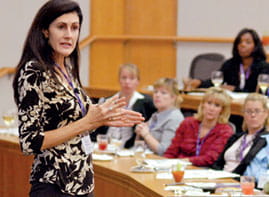
Clinical Professor Harry Kraemer ’79 leads a panel discussion on the four principles of values-based leadership

By Daniel P. Smith

5/11/2011 - Are great leaders born or made?

In a word, Harry Kraemer ’79 answers: “Yes.”

Natural gifts may provide you with a head start, but a consistent focus on values-based principles help you maximize your leadership potential, said Kraemer, former CEO of global healthcare company Baxter and a clinical professor of management and strategy at Kellogg.

Kraemer, author of the new book From Values to Actions: The Four Principles of Values-Based Leadership, shared his message with more than 200 students and guests during a panel discussion presented by Kellogg Leadership Initiatives on May 5. While the event celebrated the release of Kraemer’s book, it also sparked a broader conversation about leadership with four additional panelists with diverse experience and industry backgrounds.

Panelist Dev Patel ’08, an engagement manager at McKinsey & Company, described Kraemer’s four values as instruments in a tool box that are extracted, depending on timing and situation, to “make life simpler, clearer and ultimately better.”

Kraemer’s four values-based leadership principles include:

Self-reflection. Kraemer labeled self-reflection — the process of silencing the noise and identifying goals — as leadership’s fundamental principle.

“People need to sit down and decide who they want to be,” he said.

Karen May, Kraft Foods executive vice president of global human resources, addresses challenging issues by asking herself if she can live with the decision and explain her rationale to others.

“If you self-reflect,” Kraemer noted, “then you don’t get involved with ‘could’ve, would’ve, should’ve.’”

Balance. While the world can consume leaders in a whirlwind of dynamics, politics and winning, Kraemer defines balance as the second key principle. Though it may be easy to express one’s individual views, Kraemer says leaders must understand other perspectives and explore issues beyond black-and-white terms.

Self-confidence. Not to be confused with being correct, self-confidence includes knowing one’s limitations and being vulnerable, both of which heighten a leader’s ability to make beneficial decisions. Furthermore, self-confidence inspires the entrepreneurial and innovative spirit that moves the world forward.

“Genuine self-confidence creates a willingness to take risks,” Gorman and Company president Gary Gorman said.

Humility. With his final principle — humility — Kraemer urged students to find people who will challenge ideas and maintain focus.

“You need to realize that you’re not right a lot of the time,” Big Brothers Big Sisters of Metropolitan Chicago CEO Art Mollenhauer said, adding that humility requires leaders to recognize the world beyond their own ideas.

While Kraemer acknowledged that few leaders possess all four values, he advised students to identify those who excel in certain areas and model those effective traits.

“And the more you know, the more you’ll realize how much better you can become,” Kraemer said.