The web-counter
says that you are visitor number  since June 9, 2007.
Last
updated: May 25, 2023 by JVM .
More
on Operations Strategy: Principles and Practice
THE
OBJECTIVE OF THIS OPERATIONS STRATEGY BOOK
is to convey how operations strategy can increase
value by tailoring a set of core principles to a specific
business practice.
THE
EDUCATIONAL PHILOSOPHY OF THIS OPERATIONS STRATEGY
BOOK:
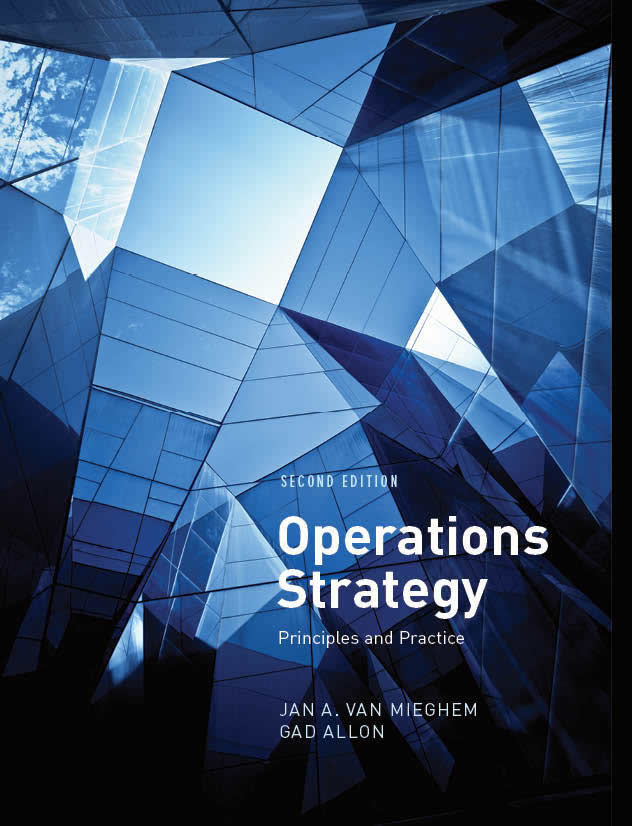
Operations strategy is as much art (hence the cover)
as it is science (hence the content). Designing
and implementing a successful operations strategy
requires judgment, experience, creativity, and luck,
all of which cannot be taught. What can be taught,
however, are the concepts, principles, and tools
to help the reader in that process---and therein
lies the purpose of this book.
“Principles and practice” is the guiding
motto throughout this book. Each chapter opens with
a description of how a real company practices some
aspect of operations strategy and then reviews the
concepts behind that practice. Tools are provided
to analyze the concepts, distill their principles,
and suggest guidelines for implementation and improvement.
Each chapter closes with a mini-case to explore
how one would apply the principles and tools in
practice. The book ends with a set of “full-blown”
cases (of the Harvard type) that serve to integrate
the chapters and emphasize their relevance to practice.
DISTINGUISHING
FEATURES OF THIS OPERATIONS STRATEGY BOOK:
- This book presents a novel structured approach
of using analysis to build intuition in operations
strategy and reveal improvement levers within a
coherent framework.
- The dual emphasis on principles and practice
is reflected by analytical models that are illustrated
with detailed examples and a dozen case studies
of real business situations. Throughout the book,
financial value is our yardstick and our guide to
assess and improve operations strategy.
- When appropriate, state-of-the-art research findings
are integrated in the discussion. For example, chapter
5 uses newsvendor network analysis and simulation-based
optimization to value network flexibility; chapters
6 & 9 discuss operational hedging in global
networks and offshoring; chapter 7 examines structured
sourcing contracts to balance incentives and risk;
chapter 8 applies revenue management techniques
to capacity allocation and sourcing, and chapter
10 links operational improvement to innovation and
competition.
- This book addresses questions of a more strategic
nature than those covered in a core operations course
or in more specialized electives in service or supply
chain management, but of a more operational level
than a competitive strategy class. Nevertheless,
all concepts are explained “from scratch”
to make the book self-standing without prerequisites.
- To increase accessibility, most analysis is described
in words and is exhibited with minimal notation
and mathematics. For example, equations are stated
only if they capture a relationship better than
words alone can.
- To increase usefulness and illustrate implementation,
a particular example of each analysis is worked
out in a spreadsheet (all spreadsheets can be downloaded
from www.vanmieghem.us). More advanced analysis
or spreadsheet implementations are relegated to
appendices for those who are interested.
WHAT'S NEW in the SECOND EDITION:
This second edition contains changes along various dimensions. First, Professor Allon has joined this ongoing book project as second author. In 2010, Gad started teaching the MBA elective course, Operations Strategy, that Jan began designing
and teaching in 1998. Second, while the first edition followed a “leading strategy,” in the sense that it contained material that hadn’t been taught yet, this second edition reflects how our MBA elective course has evolved over the last 7 years. It thus contains “class-room tested content.”
These two changes led to a new chapter 2; majorly revised chapters 1, 3, 4, 5, 6, and 7 and appendix A; and minor revisions of the remaining chapters.
While we believe significant progress has been made, this book project remains a process of continuous improvement. It never ends, as better ways always exist. If you have any suggestions for improvement, we welcome hearing
about them.
COMMENTS
FROM REVIEWERS OF OPERATIONS STRATEGY (Ed. 2):
"This book provides a new pedagogical foundation for courses in operations strategy, by developing key concepts through
analytical models and intuition within a coherent framework. Professors Van Mieghem and Allon seemlessly integrate basic knowledge in the area with the latest academic research and their own business cases. The result is a truly outstanding book that chronicles the frontier of thought in the area"
Professor Dan Adelman
The University of Chicago Graduate School of Business
"Van Mieghem and Allon are the world’s leading authorities on operation strategy. Their new book provides the definitive source for essential knowledge on how to use operations to drive long-run value creation. Through their highly inter-functional and coherent framework, concepts and tools are clearly illustrated, allowing a manager to immediately and effectively implement these learnings into actual practice. This book is unquestionably a must read for anyone who needs to know how to use operations for competitive advantage."
Professor Gerard P. Cachon
The Wharton School - University of Pennsylvania
“This textbook provides a seminal contribution to the teaching of operations strategy in the MBA curriculum. Thoughtful discussions of fundamental strategic choices , facing the twenty first century global enterprise, are artfully combined with insightful analytical models.”
Professor Awi Federgruen
Graduate School of Business, Columbia University
“This is an impressive book that provides a totally new perspective on operations strategy and how to teach it. The authors do a marvelous job at developing a model-based framework for understanding operations strategy; the book draws heavily on operations management research to extract principles for operations strategy and then demonstrates how these principles guide and apply to practice through illuminating real-world examples and cases. This is an outstanding contribution for our community and our students.”
Professor Stephen C. Graves
Massachusetts Institute of Technology (MIT)
"Van Mieghem and Allon's book shows us forcefully and insightfully how companies can structure their operations strategy to build overall business values. It is such a beautiful and complete treatment that it is a book for all operations managers and students, as well as for practitioners in all functional areas."
Professor Hau Lee
Graduate School of Business, Stanford University
“Many firms adapt product strategy to changing markets but keep operational processes unchanged. This book provides a novel, integrated, yet easily accessible approach to link operations with the strategic view of the CEO. Highly recommended.”
Professor Nils Rudi
INSEAD “Operations Strategy does an excellent job in providing a non-overwhelming description of the underlying theory and then illustrating it with case studies and examples. The book contains many fascinating topics which are simply not covered elsewhere: capacity timing, capacity flexibility and operational hedging, to name just a few. Students, practitioners and academics alike will appreciate the easy-going approach of the book and a wealth of managerial insights that it offers.”
Professor Serguei Netessine
The Wharton School, University of Pennsylvania
“Insightful and fun! Van Mieghem and Allon have done a masterful job of covering the important issues in operations strategy in a structured and engaging manner. This book introduces each topic in a separate chapter with a current example from a well-known company or industry, and wraps up each chapter with a more detailed case study after reviewing the relevant concepts in depth. Any instructor who plans to teach a course on operations strategy, should consider using this book as the text.”
Professor Ananth Raman
Harvard Business School
|