|
|||||
|
|
|
|||||
|
|

 |
|
|
|
|
|
|
|
|
|
|
|
|
|
|
|
|
|
|
|
 |
|
||||||||||||||||||
 |
 |
 |
 |
 |
 |
 |
 |
 |
 |
 |
 |
 |
 |
 |
 |
 |
 |
|
|
By Paul Schaafsma
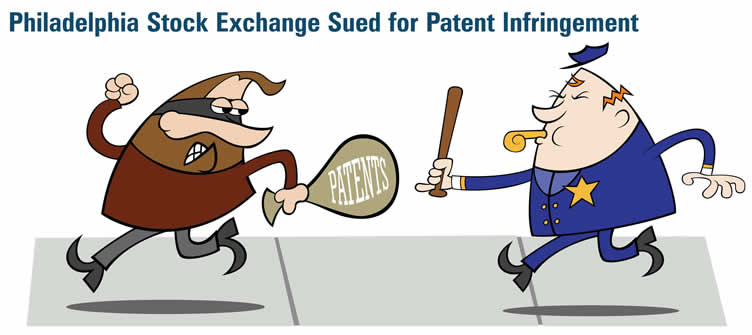
A recent lawsuit against the Philadelphia Stock Exchange evidences the growing infusion of patents into the financial community.
On June 2, 2006, NexTrade Holdings, Inc., sued the Philadelphia Stock Exchange in a Tampa federal court for infringement of NexTrade’s patents directed towards “expirationless” options or “XPOs.” Founded in 1995, Clearwater, Florida-based NexTrade Holdings developed a NexTrade electronic communications network that was operated through its wholly owned subsidiary, OnTrade, Inc., and competed against Archipelago and Bloomberg’s Tradebook. In January of this year, on the trail of the New York Stock Exchange’s purchase of Archipelago Holdings, Citigroup, Inc., bought OnTrade. Ironically, Citigroup also holds a stake in the Philadelphia Stock Exchange. Now NexTrade is focusing their attention on their XPOs.
According to NexTrade’s website (http://www.xpotrade.com), “XPOs are options that simply have no expiration date, they are patent protected on all underlying assets including: equities, bonds, currencies and commodities.
In June of 2005, amid much fanfare, and following discussions with the Chicago Board of Trade, NexTrade and the Philadelphia Stock Exchange announced that they had entered into a license agreement for the XPOs. NexTrade’s founder and CEO John Schaible commented that “. . . our growth pattern for the XPOs is that we are not just going to be trading XPOs on ETFs, but also eventually futures, currencies and a number of other products. The PHLX is the perfect partner for that because they’re already authorized to trade in those products.”
Apparently not.
The Complaint filed in Tampa alleges that a PHLX officer told NexTrade that the exchange could not trade the options because of software problems. NexTrade claims that these software problems were merely a ruse to hide the exchange’s failure to develop the products. At the same time, according to the Compliant, the PHLX was petitioning the SEC for a rule change so that the PHLX could sell its own long dated options, or LDOs, with expiration terms of 10 years.
The youngest of NexTrade’s patents, US Patent 7,024,384, is titled “Apparatus and Process for Calculating an Option.” The patent has a long family lineage. It is based on an application originally filed in 1994, which was succeeded by two additional applications, all of which have resulted in three additional issued patents: US Patents 6,263,321; 5,884,286; and 5,557,517. The patents were invented by Vergil L. Daughtery III, a former paratrooper and Georgia Tech grad who had previously worked setting up nonprofit group homes for disabled people. Daugherty, who licensed the patents to NexTrade, has said that the idea occurred to him while he was a student of economics at Georgia Tech in the early 1990s. The Black-Scholes-Merton model of option pricing presumes that a perpetual European option has the same value as the underlying stock. But Daugherty saw an error in this logic: A European option, by definition, is an option that can only be exercised at expiration. A perpetual European option, then, can never be exercised, which sounds valueless. This realization led to his work in “expirationless” options and his resulting patents. PHLX will doubtless rely on the two classic defenses to patent infringement – non-infringement and patent invalidity. NexTrade will need to show that these “10-year” options infringe the patents on “expirationless” options. And even before the lawsuit the financial press had expressed skepticism regarding the validity of the Daugherty patents.
For example, a July 2004 article in Scientific American cited the patents as an example of the broken state of the U.S. Patent system: “If such a [reformed] procedure had been in place in 1999, Vergil L. Daughtery, III, of Americus, Georgia, would probably not have been able to get his first patent for a certain type of financial instrument – “an expirationless option” – that had been anticipated during the 1960s in papers written by economist Paul Samuelson of the Massachusetts Institute of Technology.”
In another article suggesting patent reforms, Adam Jaffe and Josh Lerner (2005) went a step further, flatly stating: “[I]nfinitely lived options are not a new idea. In fact, it is considerably easier to value infinitely lived options than to value those with a distinct life span, which is why a Nobel Prize was awarded for solving the finite-lived option pricing problem. Economist Paul Samuelson (both alone and with Bob Merton) had solved the pricing of perpetual options in the mid-1960s, well before Fischer Black, Myron Scholes, and Merton analyzed the pricing of finite-lived options. To be sure, most introductory MBA finance classes don’t get around to discussing the pricing of perpetual options because they are not as ubiquitous as finite-lived options. Nonetheless, the subject has been dissected in literally dozens of articles, many written by Nobel Laureates such as Merton and Samuelson.”
A more favorable article appeared in the December 2003 issue of Inc. Magazine. That article noted that, “There have been academic papers about ‘perpetual options,’ but nobody before Vergil seems to have thought to give it a try in the real world.” And author Robert Cringely points out that, “according to the early work of Fischer Black and Myron Scholes (the twin gods of derivative securities), XPOs ought not to function at all as a financial instrument,” thus reinforcing the argument that Daugherty was inventive in going against the prevailing paradigm.
But the classic patent fight is not all that is at issue. In addition to the patent dispute, NexTrade has also alleged that PHLX breached a “best efforts” clause in the license agreement. Thus, the PHLX is likely to discover what technology companies learned the hard way: far better to have objective development criteria than a vague “best efforts” clause – after all, how much effort is “best?” One PHLX defense? There is simply no market for perpetual options. Cringely’s article inInc. Magazinecontains widely differing opinions on the market potential. David Weinberger, who is identified as running “a large trading operation for a major financial institution in Chicago,” is quoted as saying, “I don’t believe there will be any meaningful trading in these options beyond some short initial period.” On the other side, William Margrabe, who is identified as a derivatives consultant in Pelham Manor, New York, who has worked at Salomon Brothers Morgan Stanley and Bankers Trust, and who was Fischer Black’s research and teaching assistant at the University of Chicago, says, “Some sort of XPO could be part of an optimal corporate finance solution.” And in the end that might just be the real point – let the marketplace decide. References
Paul Schaafsma is a former regular columnist in FEN. He can be reached at pschaafsma@fenews.com |
 Measuring Market Risk, 2nd Edition |
 A Mathematician Plays the Stock Market |
 Seven Signs of Ethical Collapse |


